
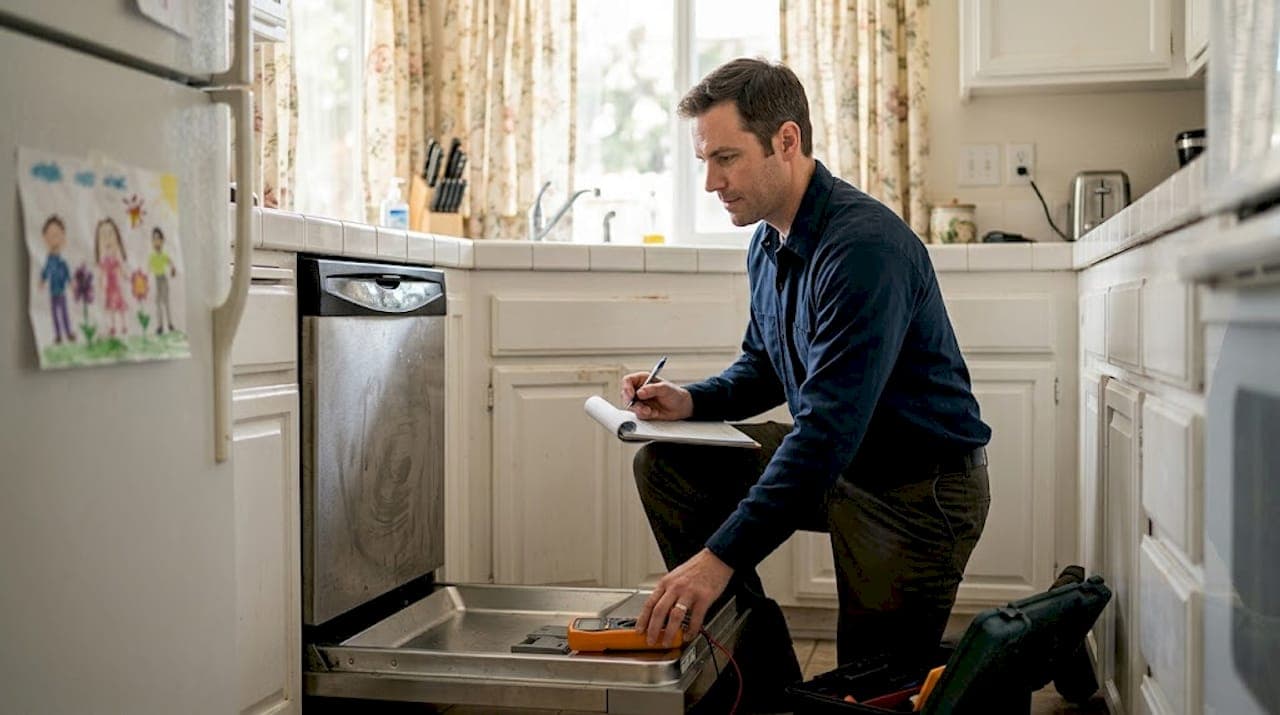
Most appliance failures that end in a repeat service call share one thing in common: the technician skipped a diagnostic step. Industry benchmarks show a first-time fix rate target above 80 to 90 percent, yet poor diagnostics account for 68 percent of repair delays. That gap costs homeowners real money, with the average service call running around $275. The good news is that a structured, scientific approach to troubleshooting closes that gap fast. This guide walks you through exactly how to apply that method, from the first symptom to final verification, so your appliance gets fixed right the first time.
Table of Contents
- What is scientific troubleshooting in appliances?
- Step-by-step guide: Applying the scientific method to appliance diagnosis
- Effective diagnostic tools and the Hopscotch method
- Advanced troubleshooting: Handling edge cases and smart appliances
- Why systematic troubleshooting wins: An expert perspective
- Get expert appliance diagnostics in Fox Valley
- Frequently asked questions
Key Takeaways
| Point | Details |
|---|---|
| Systematic process wins | Following a scientific troubleshooting method leads to faster, more reliable appliance repairs. |
| Tools and methods matter | Using proven diagnostic tools and techniques dramatically reduces guesswork and wasted parts. |
| Edge cases need care | Advanced tactics and post-fix verification are critical for tricky faults and modern smart appliances. |
| Know when to call pros | DIY is best for simple problems, but complex or high-risk faults require expert help. |
What is scientific troubleshooting in appliances?
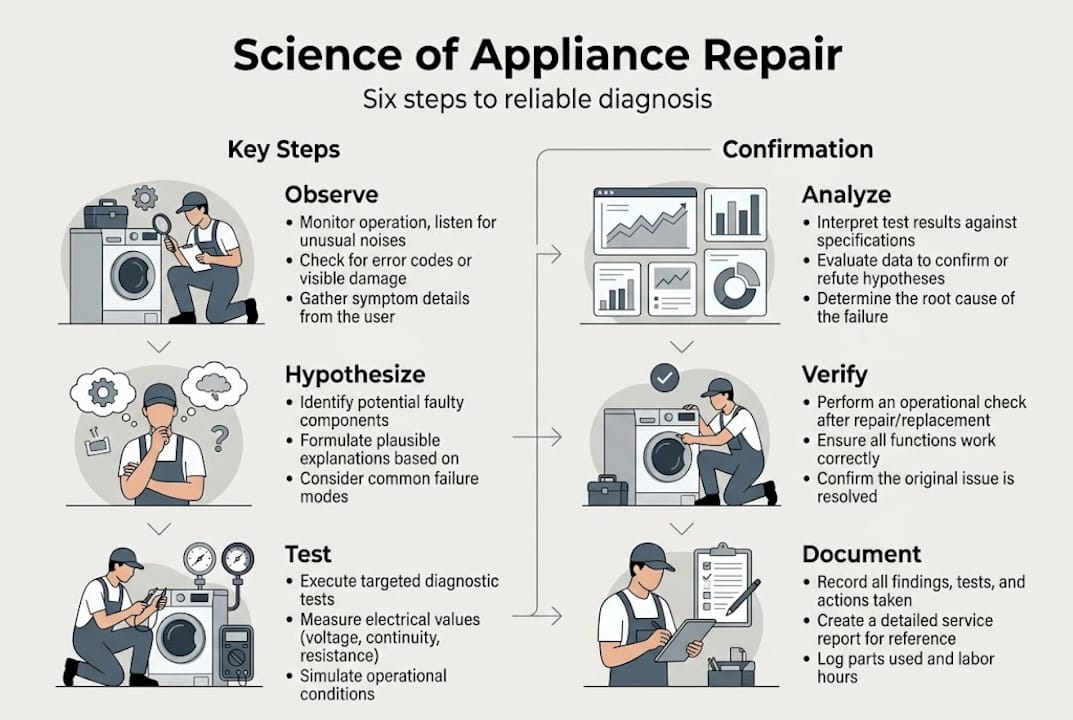
Scientific troubleshooting is not a buzzword. It is a structured process borrowed directly from the scientific method and applied to the real-world behavior of household appliances. Instead of swapping parts and hoping for the best, you observe, hypothesize, test, analyze, and confirm. Every step builds on the last.
Scientific troubleshooting in appliances applies the scientific method: observe symptoms, form hypotheses on causes, test systematically, analyze results, verify the fix, and conclude. That sequence is not optional. Skipping even one step introduces guesswork, and guesswork is expensive.
Contrast that with the traditional part-swapping approach. A technician hears a clicking noise from a refrigerator, assumes it is the start relay, replaces it, and leaves. Two days later the compressor fails because the real problem was a voltage irregularity stressing the compressor windings. The part swap treated a symptom, not a cause. Using the scientific method to solve problems is systematic and reliable, which is exactly why it works better than intuition alone.
Here is a visual overview of the process:
| Step | Action | Example |
|---|---|---|
| 1. Observe | Identify symptoms precisely | Dryer runs but produces no heat |
| 2. Hypothesize | List probable causes | Thermal fuse, heating element, or thermostat failure |
| 3. Test | Run targeted diagnostics | Continuity test on each component |
| 4. Analyze | Interpret test results | Thermal fuse shows open circuit |
| 5. Verify | Confirm fix resolves symptom | Dryer heats normally after replacement |
| 6. Conclude | Document findings | Root cause: blocked vent caused fuse failure |
Measurable, systematic methods increase diagnostic accuracy because they eliminate assumption. Every test either confirms or rules out a hypothesis, narrowing the fault to its true source.
The benefits of this approach are hard to argue with:
- Higher first-visit success rates because faults are confirmed before parts are ordered
- Less wasted money on components that were never the real problem
- Safer repairs because each step includes a verification before moving forward
- Faster resolution because the fault path is narrowed logically, not randomly
For homeowners and property managers who rely on appliance troubleshooting by professionals, understanding this process helps you ask better questions and recognize when a technician is doing the job right.
Step-by-step guide: Applying the scientific method to appliance diagnosis
Now that we understand the concept, let's see exactly how to implement scientific troubleshooting in your next repair. We will use a non-heating dryer as the working example because it is one of the most common calls in the Fox Valley area.
Step 1: Observe the symptoms precisely. Do not just note that the dryer is broken. Record exactly what it does. Does it tumble? Does it run a full cycle? Is there any heat at all, or does it cycle off early? Precise observation is the foundation of every correct diagnosis.
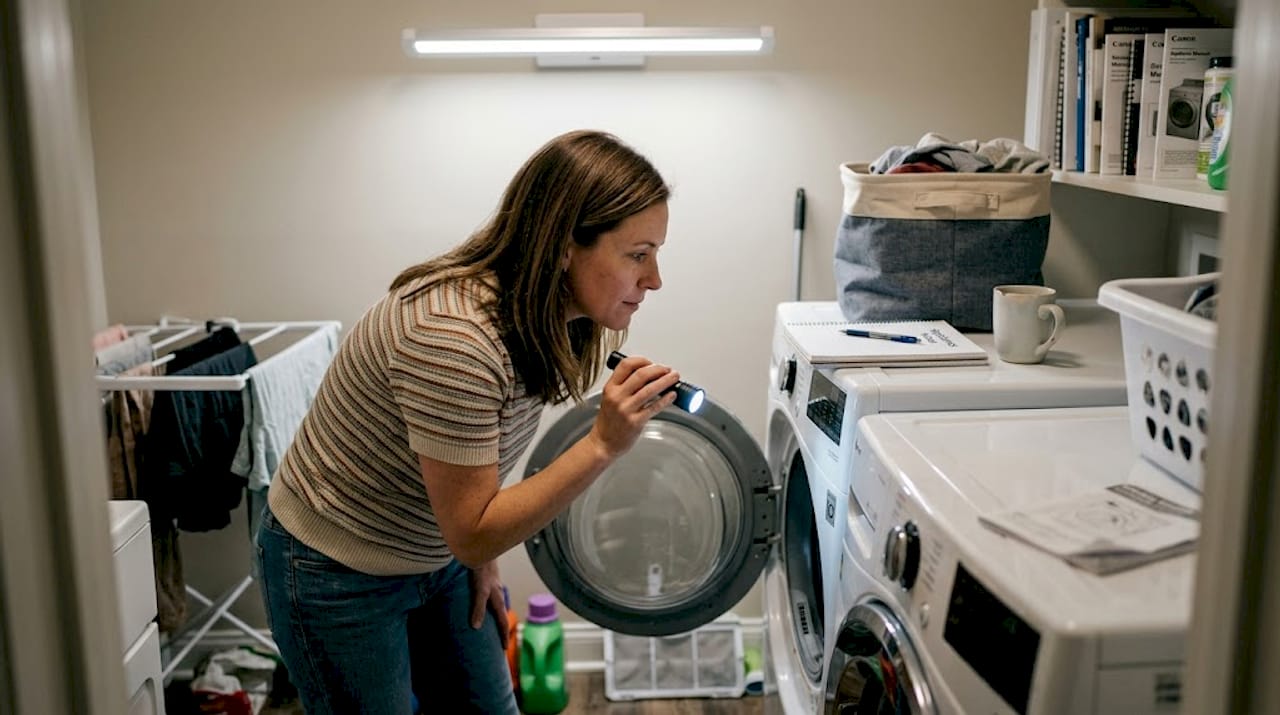
Step 2: Form a hypothesis. Based on your observation, list the most likely causes in order of probability. For a dryer that tumbles but produces zero heat, the short list includes the thermal fuse, heating element, high-limit thermostat, and cycling thermostat. Rank them by how often they fail and how easy they are to test.
Step 3: Test systematically. Observe symptoms, form hypotheses, test systematically using both visual and electrical methods. A visual check might reveal a burnt element. An electrical check uses a multimeter to confirm continuity or voltage at each component. Start with the easiest test first to save time.
Step 4: Analyze the results. If the thermal fuse shows an open circuit, that confirms it has failed. But stop there for a moment. A blown thermal fuse is almost always caused by something else, usually a blocked exhaust vent or a failing cycling thermostat. The fuse is the symptom. The blocked vent is the root cause.
Step 5: Verify the fix. Replace the fuse, clear the vent, and run a full timed cycle. Measure the exhaust temperature at the vent outlet if possible. Confirm the dryer reaches operating temperature and completes the cycle without tripping again.
Step 6: Document and conclude. Write down what you found, what you replaced, and what the root cause was. This is not busywork. If the same symptom returns in six months, your notes tell you exactly where to start. Understanding the difference between DIY versus professional troubleshooting matters here because documentation is a habit most DIYers skip and most good technicians never do.
Pro Tip: Keep a simple repair log for every appliance in your home. Date, symptom, test results, parts replaced, and root cause. It takes five minutes and saves hours on the next call.
For a quick refresher on the underlying logic, reviewing scientific method basics helps reinforce why each step exists and why skipping one breaks the chain.
Effective diagnostic tools and the Hopscotch method
To make troubleshooting scientific and efficient, using the right tools and strategies is essential. Three tools show up on every professional's belt for good reason: a digital multimeter, the appliance wiring diagram, and quality test leads.
The multimeter measures voltage, resistance, and continuity. The wiring diagram tells you what voltage to expect at every point in the circuit. The test leads connect you to those points safely. Without all three, you are working blind.
The Hopscotch method takes electrical testing to the next level. The Hopscotch method involves systematic voltage testing along a circuit path, hopping component to component to find a zero-volt drop that indicates a fault. Instead of testing every component individually, you jump along the circuit in a pattern that isolates the fault zone quickly.
Here is how it compares to traditional circuit testing:
| Feature | Hopscotch method | Traditional testing |
|---|---|---|
| Testing sequence | Strategic jumps along circuit | Component by component |
| Time to fault | Fast, narrows zone quickly | Slow, tests everything |
| Skill required | Moderate (needs wiring diagram) | Basic |
| Accuracy | High, eliminates guesswork | Variable |
| Best used for | Complex multi-component circuits | Simple single-component checks |
To apply Hopscotch, start at the power source and confirm voltage is present. Then jump to the midpoint of the circuit. If voltage is present there, the fault is downstream. Jump again to the midpoint of the remaining half. Repeat until you find the point where voltage drops to zero. That is your fault location.
For more background on common appliance electrical faults, the appliance troubleshooting FAQs cover a wide range of scenarios worth reviewing.
Signs that point to an electrical fault in any appliance:
- No continuity across a component that should be closed
- Voltage present on the line side but absent on the load side
- Resistance readings far outside the specification on the wiring diagram
- Visible burn marks, melted insulation, or corrosion on terminals
Pro Tip: Always pull the wiring diagram before you test. Many appliances label the same wire differently on the diagram versus the physical harness. Misreading line versus load side is one of the most common and costly errors in electrical diagnosis.
Advanced troubleshooting: Handling edge cases and smart appliances
Beyond the basics, certain failures require more advanced troubleshooting tactics. Three categories trip up even experienced technicians: intermittent faults, hidden contamination, and multiple simultaneous failures.
Intermittent faults are the hardest to catch because the appliance works fine when you test it. The fault only appears under specific conditions, like a certain temperature, load level, or vibration pattern. The fix is to replicate the conditions that trigger the fault, not just test the appliance cold.
Edge cases like intermittent faults, contamination and overheating, and multiple failures require you to always find the root cause, test after repair, and avoid assumptions. Hidden contamination is a good example. Grease or moisture inside a control board can cause random shutdowns that look like software errors. A visual inspection under good lighting often reveals the real culprit.
Smart appliances add another layer of complexity. Smart appliances show higher problems at 87 problems per 100 units versus a 69 average for standard appliances. The connected electronics and software layers create failure modes that a basic multimeter cannot catch. Error codes help, but they often point to symptoms rather than root causes, which means the scientific method becomes even more important, not less.
Always verify the true root cause, not just the symptom. A cleared error code is not a repaired appliance.
Steps for confirming a repair and ensuring long-term reliability:
- Run the appliance through a complete operating cycle after every repair
- Measure temperatures, voltages, or pressures against specification where possible
- Check for secondary damage caused by the original fault
- Confirm that the root cause, not just the failed part, has been corrected
- Schedule a follow-up check for complex or smart appliance repairs
Post-fix testing is the step most people skip because the appliance appears to be working. Appearances are not data. A verified repair is one that passes a measurable test, not one that just seems okay.
Why systematic troubleshooting wins: An expert perspective
Having examined the process, here is a real-world take on why the scientific approach outperforms every alternative. The most common reason technicians skip diagnostic steps is time pressure. A busy schedule pushes toward the fastest probable fix, not the most accurate one. That shortcut almost always costs more in the end, through callbacks, repeat parts, and frustrated customers.
The business case is clear. Systematic diagnostics lift first-time fix rates and directly improve business performance by cutting callbacks and reducing wasted parts costs. A higher first-time fix rate means fewer return trips, lower overhead, and stronger customer trust.
What most technicians and DIYers miss is the post-repair verification step. Fixing the part is not the finish line. Confirming the repair under real operating conditions is. At Precision Home Appliance, our background in clinical laboratory science shapes how we think about every repair. In a lab, you do not report a result until it is verified. We apply the same standard to every appliance we touch.
Pro Tip: Track your repair outcomes like a business even if you are a homeowner. Note what failed, what fixed it, and whether the fix held. Patterns in that data will tell you when an appliance is worth repairing and when it is time to replace it.
Get expert appliance diagnostics in Fox Valley
Ready to put the science of troubleshooting to work for you? At Precision Home Appliance, we apply the same structured, data-driven diagnostic process described in this guide to every service call across Kaukauna, Appleton, Neenah, and the surrounding Fox Valley region.

Our process starts with a $99 diagnostic that identifies the true root cause before a single part is ordered. No guessing, no unnecessary replacements, no repeat visits for the same problem. Whether you are dealing with a smart appliance throwing confusing error codes or a dryer that stopped heating overnight, our team brings clinical-level precision to every job. Book your diagnostics and appliance repairs today and get a repair that actually holds.
Frequently asked questions
What makes troubleshooting 'scientific' in appliance repair?
Scientific troubleshooting uses a repeatable method: observe symptoms, form hypotheses, test, and verify, rather than guessing or swapping parts randomly. Every step produces data that either confirms or eliminates a potential cause.
When should I call a professional instead of troubleshooting myself?
Call a professional for high-voltage components, complex control board failures, or smart appliance issues where software and hardware interact. Visual inspections and basic continuity tests are generally safe for a careful homeowner.
What are common mistakes in appliance diagnosis?
Skipping steps, treating the symptom instead of the root cause, and failing to run a full test cycle after repairs are the most frequent errors. Avoiding assumptions and confirming every fix with a measurable test is what separates a reliable repair from a temporary one.
Why do smart appliances fail more often?
Smart appliances report significantly higher problems per 100 units compared to standard models because their complex electronics and software create more potential failure points. That added complexity also makes accurate diagnosis harder without the right tools and method.